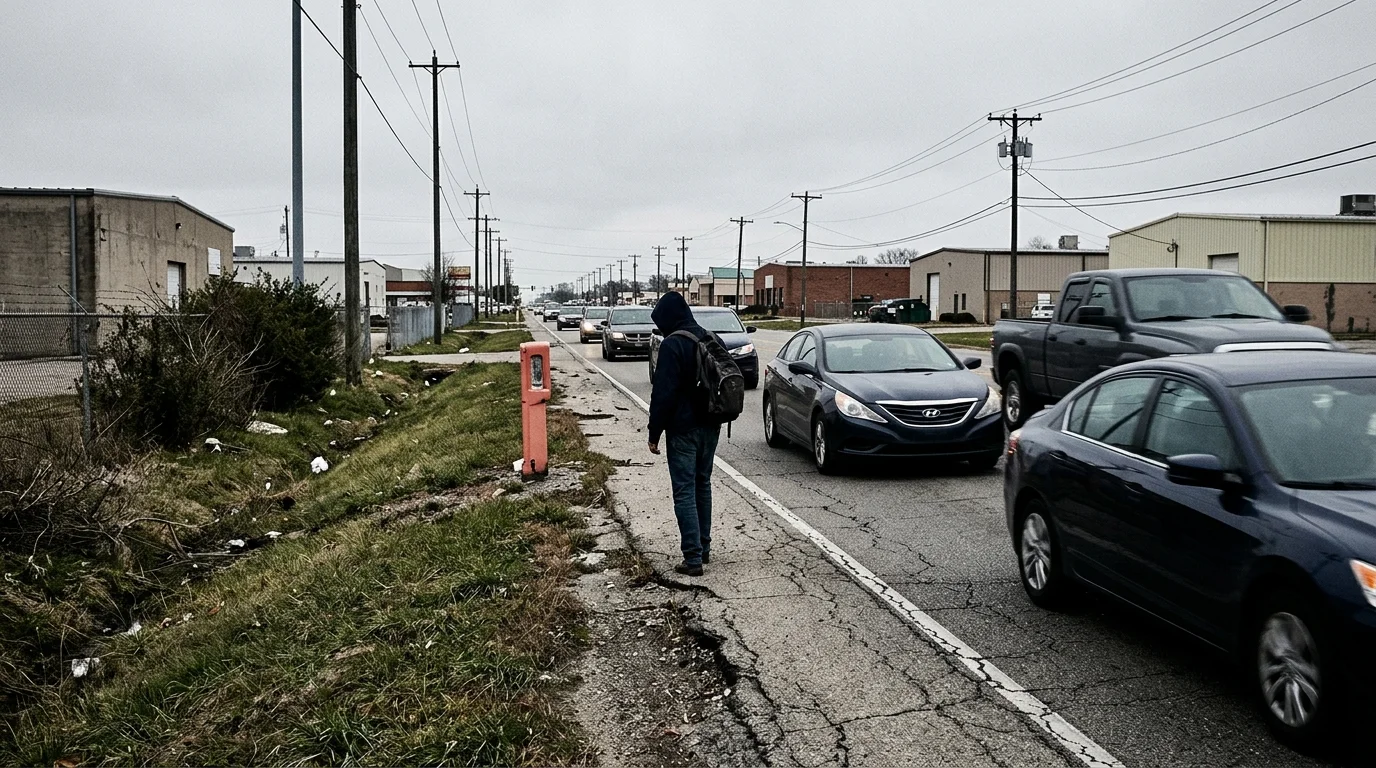
People walking to the Clermont County Public Library along US Route 50 in Ohio currently share the road with highway traffic and little else. That's about to change, with $116,419 in federal funding now obligated to build new sidewalks and pedestrian crossings along both sides of Main Street from near Johnnytown Road to the library entrance.
The stretch of US-50 in question is a classic American road problem: a state highway engineered for through-traffic that also serves as the main street of a small community east of Cincinnati. For pedestrians, especially children, elderly residents, and those without cars who depend on the library as one of the few walkable destinations in the area, the route has long meant navigating narrow shoulders alongside fast-moving vehicles.
The funding comes through the Carbon Reduction Program, a formula grant created by the 2021 Bipartisan Infrastructure Law. The program was designed to cut transportation-related emissions, and pedestrian infrastructure qualifies because sidewalks and crossings encourage trips on foot instead of by car. Ohio received roughly $107 million in Carbon Reduction Program funds over the law's five-year authorization. With a standard local match, the total project cost comes to around $145,000.
The pedestrian safety stakes are significant. Nationally, pedestrian fatalities have climbed roughly 77 percent since 2010, topping 7,500 deaths in 2022, the highest toll in four decades. Ohio has faced increasing pressure to address its own numbers through safety-focused programs like ODOT's Walk.Bike.Ohio plan, adopted in 2021. Similar federal investments have helped communities elsewhere create safer corridors, including a new multiuse path along Whitman Drive in Walla Walla, Washington.
Clermont County, home to about 208,000 residents and one of the faster-growing counties in the Cincinnati exurban ring, is predominantly car-dependent. That growth has sharpened the tension between roads built for throughput and the reality that people are already making these trips on foot, with or without infrastructure to protect them.
The grant was posted in March 2026, indicating the project is in the programming and obligation phase. Construction timing has not been announced.